
Read Sunflower County Deed Types
The Sunflower County Chancery Clerk files land instruments of many kinds. Deeds, deeds of trust, substitutions, releases, plats, construction liens, lis pendens, federal tax liens, and sectional-index entries all sit in the same record set. These entries share one record set. A deed claims a transfer of ownership interest. A deed of trust works differently. It secures a debt. A later release or substitution changes the lien record rather than the ownership transfer. Type matters before any name is treated as an owner of record.
| Deed Type | What It Does | Common Use |
|---|---|---|
| Warranty deed | Conveys the stated interest with title promises | Ordinary sale or transfer |
| Quitclaim deed | Conveys only the interest the grantor may hold | Family transfer or title cleanup |
| Trustee deed | Records a transfer by a trustee under stated authority | Trust or foreclosure-related transfer |
| Executor deed | Conveys estate property through an authorized representative | Probate administration |
| Tax deed | Records a transfer arising from the tax process | Post-sale title research |
Read Sunflower County deed records alongside their companion lien entries. A buyer can appear as grantee on a warranty deed. A deed of trust is often filed close behind. A release may show up years later. Write down the instrument number and filing date. Include the book and page, party names, and legal description. Add any related-instrument reference the record actually displays. Keep the full party spelling. Keep the document label too. Small name variants are one risk. A mistaken deed type is another, and either can drag a chain of title toward unrelated Sunflower County land.
Search Both Sunflower Index Sides
The Sunflower County Land Records search is built around recorded instruments. It also tracks the parties to them. The application labels its fields Instrument Number, File Date/Time, Parcel Number, Patent Number, Party Name, Related Instrument Number, Related Book and Page, Return To Name, and Receipt Number. Not every field appears in every search mode. Start with a party and a broad date range. Then narrow the search with the exact reference from a result.
| Search clue | Use in the index | Save from the result |
|---|---|---|
| Party name | Test the person or entity as grantor and grantee | Exact spelling and party role |
| Instrument number | Open one known filing | Filing date and page count |
| Book and page | Retrieve a cited deed-book entry | Image and related references |
| Parcel number | Test a parcel-based search when offered | Legal description and cross-links |
The image comes from the official county application. It shows the search surface for instrument and party research. Open the official Sunflower land-record search before relying on an image or index entry.
An online field or image can be incomplete. The courthouse Land Records Index still controls when it is.
Know Sunflower Deed Coverage
The Land Title Association of Mississippi reports online Sunflower land records from 2005 forward and no judgments online. Treat that as a coverage lead, not a promise that every instrument or image appears. The county calls its web index a convenience copy. The courthouse Land Records Index is the official one. Older paper books are also being scanned. A missing web hit may still exist at the counter.
Coverage check. Treat 2005 as reported online coverage and ask the Clerk to confirm older books, plats, and any missing image.
Walk Sunflower's Grantor-Grantee Chain
A grantor gives an interest. A grantee receives it. The chain of title is the ordered trail of transfers for the same land, so start from a verified present deed rather than a loose same-name result. Match the legal description, parcel clue, and prior reference before stepping back one transfer.
- Find the present owner's acquisition deed by searching that party as grantee.
- Record the grantor, filing date, legal description, and prior deed reference.
- Search that grantor as a grantee and match the same land description.
- Repeat until online coverage ends, then continue through courthouse books or archive leads.
- Grantor
- The party transferring the stated interest.
- Grantee
- The party receiving the stated interest.
- Chain of title
- The linked sequence of recorded transfers for the same land.
- Book and page
- A volume-and-page citation for a recorded document.
- Instrument number
- A unique filing reference assigned to a recorded instrument.
Pair Sunflower Deeds With Plats
Deeds alone rarely tell the whole story of a Sunflower County parcel. Rural acreage is usually indexed by section, township, and range, or by a long legal description. Platted land leans on the subdivision name, lot, block, and a Map/Plat Book reference. The state GIS layer carries DEEDREF, PLATREF, SUBNAME, SECTION, TWSP, RANGE, and legal-description fields. Each one can hand you a fresh search lead. Treat them as clues, though. They never stand in for the recorded deed itself.
Liens deserve their own separate hunt. Construction liens, federal tax liens, lis pendens, deeds of trust, substitutions, and releases can all shape a title packet. They are not deeds. The association reports that judgments are not online for Sunflower County. Ask the Clerk or the right court about that stream. A careful property search keeps the empty results alongside the matches. Knowing what is absent matters too.
Extend Sunflower Land Research
The Mississippi Department of Archives and History Sunflower finding aid lists courthouse land records from 1857 and 1872 along with other county series. Historic assessment material also survives in state collections. Those records can clarify an early land entry, a former place name, or an assessment year. They are not a ready-made chain of title.
Ask MDAH for the exact series, box, roll, or item citation. Ask whether the material is original, microfilm, or digitized. The Henry M. Seymour Library's local-history resources can add maps, newspapers, family histories, and oral-history clues. Return every useful clue to the official deed books. Match the land description before joining people across decades.
Date Each Sunflower Deed Result
A Sunflower County deed carries several dates. Execution, acknowledgment, filing, and effective dates mark different events. Start with the filing date and time shown in the index. Then read the instrument for the rest. Before comparing a deed to the GIS DEEDDATE field or the tax roll, note each source's vintage, since a late-year filing may lag in the next assessment workflow.
Keep every conflict visible. Matching owner names prove little. A split tract can retain an older address. The same name may not mean the same person, and an entity may have renamed itself. Log the access date, parcel key, party names, instrument reference, and legal description so the chain stays reproducible.
Entity-owned land needs one more identity check. Search the exact grantee name in the Mississippi Secretary of State business database, and retain the Business ID, legal name, status, and filing date. Companies sometimes hold deeds under former names. An entity can also linger in the land index after an administrative status change. The business record explains the entity but never replaces the deed or proves the signer's authority for a transfer.
Obtain a Sunflower County Deed
Paid online copies are available. The Chancery Records Online landing page sells deed copies by card and lists a 3.5 percent service fee with a $2 minimum. Payments are nonrefundable. Office hours run Monday through Friday, 8:00 a.m. to 5:00 p.m. An online copy is only a convenience. It carries no official-index status and no title opinion.
The Chancery Clerk holds the controlling index. Contact the Sunflower County Chancery Clerk at 200 Main Street, PO Box 988, Indianola, MS 38751, or call 662-887-4703. The listed email is gmcintosh@sunflowerms.net. Say whether you need a plain or certified copy. Give the instrument number or book and page, name the parties, and ask the office to quote the current copy and certification charge. In-person inspection and mail requests still matter when the website fails or an older deed has not been imaged.
A narrow written request saves time. Include the grantor and grantee spelling, an approximate filing range, the parcel number, the legal description, and any related instrument. Ask about index searches, image legibility, and certification wording. If a search must reach older deed books or plats, request an estimate before authorizing paid staff time. The Mississippi Public Records Act permits public inspection and copying, subject to exemptions and reasonable actual costs, but it never requires the Clerk to create a title report or decide which deed controls.
The official landing page shows more than payment terms. It displays the county's access notice, office hours, disclaimer, and online-copy rules. Review the official Sunflower Chancery Records notice before ordering. That notice also explains the courthouse's role when records fall outside the online system.
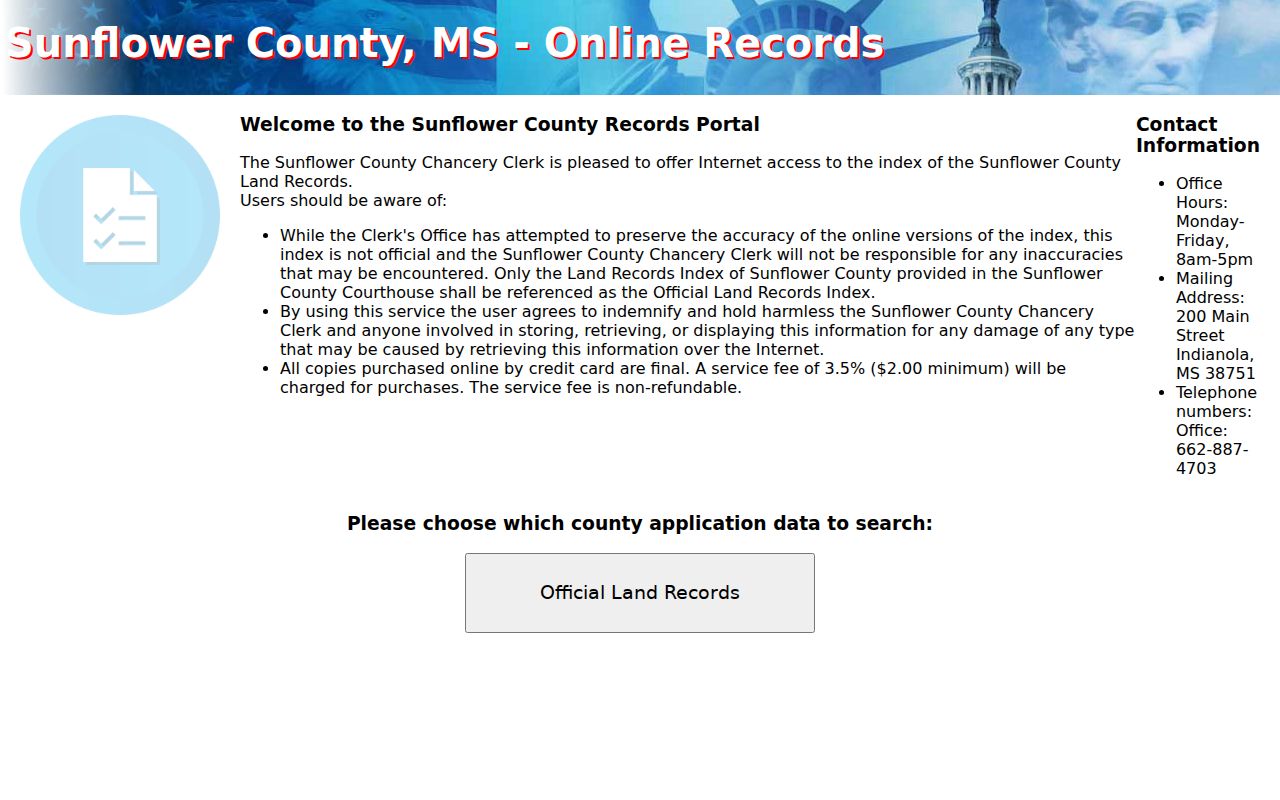
Older entries and missing images lead to the courthouse.
Recorded, not guaranteed. A Sunflower deed record shows a filed instrument. It does not prove clear title or rule out unrecorded interests.