
Read Sunflower County Tax Fields
Sunflower County property tax records pull together details from the assessment roll. The collection account adds the other half of the picture. The official DSM inquiry offers Name, Parcel Number, and Address search modes. The state GIS layer adds its own assessment clues, including land value, improvement value, total value, tax year, and tax status. Parcel identifiers appear there as well. The DSM publishes no public receipt tab or value-history feature.
| Field | What It Shows | Where |
|---|---|---|
| Land and improvements | Separate components behind total value | Assessor roll and GIS snapshot |
| Assessed value | Taxable value after the class ratio | Assessor roll |
| Exemption | Approved relief affecting the account | Assessor/Collector |
| Tax and payment status | Amount billed, paid, due, or delinquent when displayed | DSM tax inquiry |
| Parcel and tax year | Keys needed to compare sources | DSM and GIS |
Start with market value. That is the assessor's estimate of full worth on the roll. Assessed value comes next, meaning the taxable share set by Mississippi property classes. Neither figure equals a deed's stated sale price or a fresh appraisal. The tax bill applies local levies to the assessed base. It does so after any lawful exemptions and credits.
Use Sunflower Tax Search Modes
Open the Sunflower real-property tax inquiry and let its county-specific query string load. Begin with the strongest key you have. A parcel number locks onto one confirmed account. An address works when the street name is stable. An owner name can surface every parcel held by one taxpayer. When CAMA, PARNO, or PPIN variants appear, keep them. Systems often label the same join key in different ways.
| Search mode | Best use | Cross-check |
|---|---|---|
| Name | Find accounts tied to an exact taxpayer label | Mailing address and parcel |
| Parcel Number | Retrieve one known tax account | CAMA, PARNO, or PPIN |
| Address | Locate a site when no parcel key is known | GIS SITEADD and SCITY |
The official tax page displays Sunflower County's name and its public inquiry route. Open the official county tax inquiry to run the current search.
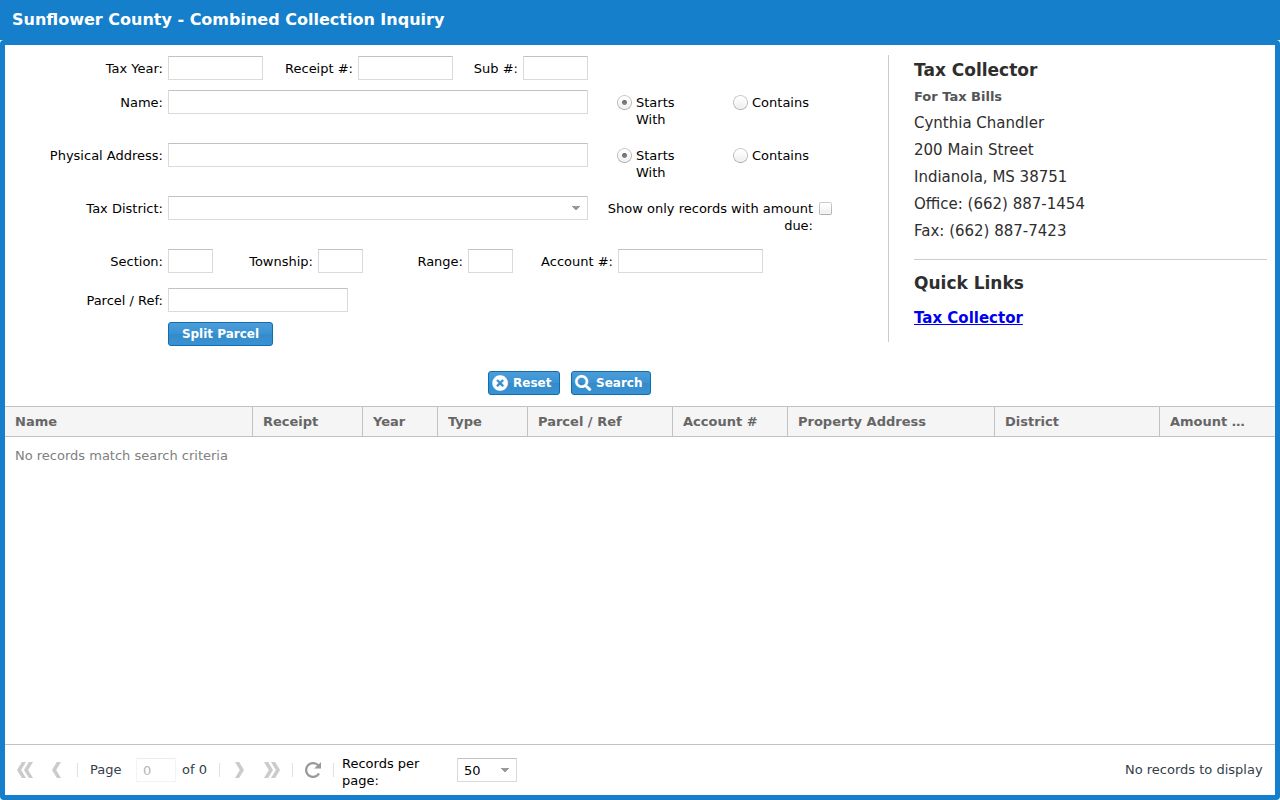
That page marks the correct source. Account details and current payment status still call for a live result or a call to the office.
Retrieve a Sunflower Tax Account
A repeatable lookup keeps the search and the interpretation apart. Write down the full county URL, the exact query, and every parcel identifier. Record the tax year and the access date before comparing values. If a receipt will not display, DSM suggests clearing the browser cache. The office also recommends contacting the county directly. Never assume a payment is missing just because the screen stays blank.
- Choose Sunflower County and search by parcel, address, or name.
- Confirm the site address, taxpayer label, and parcel keys against the GIS layer.
- Record the assessment year, value fields, exemption, bill, payment, and delinquency data that actually appear.
- Ask the Assessor/Collector for a parcel card or receipt when the online account is incomplete.
- Market value
- The assessor's estimate of full value for the roll.
- Assessed value
- The value after the statutory property-class ratio is applied.
- Millage or levy
- The local rate applied to assessed value to compute tax.
- Homestead exemption
- Approved tax relief for a qualifying owner-occupied home.
- Tax lien
- A public claim arising from unpaid property tax.
Calculate Sunflower Property Tax
The Mississippi Department of Revenue property-tax guidance walks through the math in order. Tax starts from true value, then applies the class assessment ratio and local millage. Class I owner-occupied residential real property is assessed at 10 percent. Class II, covering other real property, is generally assessed at 15 percent. Utility property falls under Class III at 15 percent as well. Personal-property classes carry their own ratios.
Never multiply a market value by a tax rate until you know the class and the assessed base. City, school, county, and special levies can all feed the final bill. The tax account and the adopted levy records fix the amount due for a given year. A rough statewide formula will not do it.
A bill can change without the market value moving at all. Classification, exemption status, the assessed ratio, and local millage each shift the total. Compare identical fields across the same tax year. An owner label can change after a sale. Check whether the value, exemption, and bill still sit on the old roll before reading any trend. Sunflower County staff can name the source year. They can also explain which office controls a disputed field.
File Sunflower Homestead Claims
Mississippi homeowners claim the homestead exemption through the county Tax Assessor. The state's homestead exemption guidance explains the rules. The filing window runs January 1 through April 1. Eligibility turns on owning and occupying the home on January 1. Other statutory conditions apply as well. The application is simpler when you come prepared. Gather the deed or legal description, the purchase price, Social Security numbers for yourself and your spouse, and your vehicle tags. The county may also ask for a few more items, so call ahead before you drive over.
One caution is worth noting. An exemption appearing on a prior Sunflower County property tax record does not carry over to a new owner. It also does not survive a changed use of the land. Assessor/Collector Cynthia Chandler can confirm current requirements at 662-887-1454 or cchandler@sunflowerms.net. She can tell you whether a change in ownership must be reported.
Separate Sunflower Tax-Sale Records
Mississippi property tax comes due February 1. Unpaid land can move toward an August sale under the state schedule the DOR describes. Delinquency, sale, forfeiture, redemption, and a later tax deed are distinct events. They are not one continuous record. Note the assessment year and any sale or forfeiture date. Also note the purchaser or status, redemption facts, and every recorded follow-up instrument.
The Secretary of State tax-forfeited-property search stands apart from the county tax inquiry. It accepts county, address, subdivision, parcel number, and PPIN. Assessed owner, legal description, market-value range, and section-township-range criteria also work. A listing there promises nothing about availability, liens, or clear title.
A real sale check runs past the list itself. Ask the county for the sale and redemption record. Search the Chancery land index for a tax deed or later instrument, and hunt for superior liens. Keep the parcel number and PPIN exact. Mailing addresses and assessed-owner labels often lag behind reality. State auction materials also warn that property moves as-is. No public tax record stands in for a legal opinion on redemption, possession, or marketable title.
Reconcile Sunflower Value Dates
The parcel service is labeled April 2024. It also carries a feature-level TAXYEAR. That label does not mean each polygon or value was refreshed the same day. State rules use June 30 deed-change timing for roll work. So a later recording can land in a later cycle. The county publishes no stated refresh interval for the tax layer.
Preserve both results when GIS and tax values differ. Ask the Assessor/Collector which roll is current. Ask what each field means. That beats picking the higher figure or whichever screen looks newer.
Request Sunflower Tax Records
Sometimes the online property search comes up empty. No parcel card, no tax bill, no exemption flag. When that happens with a Sunflower County property tax records lookup, stop. Go straight to the office. Sunflower County Tax Assessor/Collector Cynthia Chandler is listed at PO Box 1080, Indianola, Mississippi 38751. The phone is 662-887-1454, the fax is 662-887-7423, and the published email is cchandler@sunflowerms.net. Include the site address. Include every parcel or PPIN variant you know. Give the owner of record label and the exact tax year. Ask which records exist. Ask whether you can inspect them, get them by email, or receive mailed copies.
Name the fields you want instead of requesting an undefined full file. Land value, improvement value, total market value, and assessed value are a good start. Class or use, exemptions, gross tax, credits, payments, and any balance matter too. So do the receipt number and date, delinquency status, and tax-sale standing. Request only the fields the office keeps. The Mississippi Public Records Act generally allows inspection or copying unless an exemption applies. Fees can cover reasonable search, review, duplication, and mailing costs.
Open records still have limits. Ask the office to set aside any exempt material and release the public remainder. A tax account documents the parcel and the revenue tied to it, nothing more.
Contest a Sunflower Assessment
Start informally. Sit down with the Sunflower County Assessor. Request the parcel card and the classification. Ask for the land and improvement figures, the exemption status, and every data point behind the appraisal. Bring support if you have it. A deed, a survey, photographs, or repair documentation can help. Comparable sales or an independent appraisal also work, so long as they speak to a genuine error in the property records.
If the informal talk goes nowhere, the formal route sits with the county Board of Supervisors. That board runs local equalization under DOR guidance. The roll lands by the first Monday in July. It stays open for inspection ahead of the August equalization meeting. File objections on time under the local notice and state procedure. A taxpayer still aggrieved afterward can take the statutory appeal path, keeping written decisions and filing dates in hand.
Act on the notice. Confirm the current inspection and objection dates with Sunflower County because a missed local deadline can end that year's review.